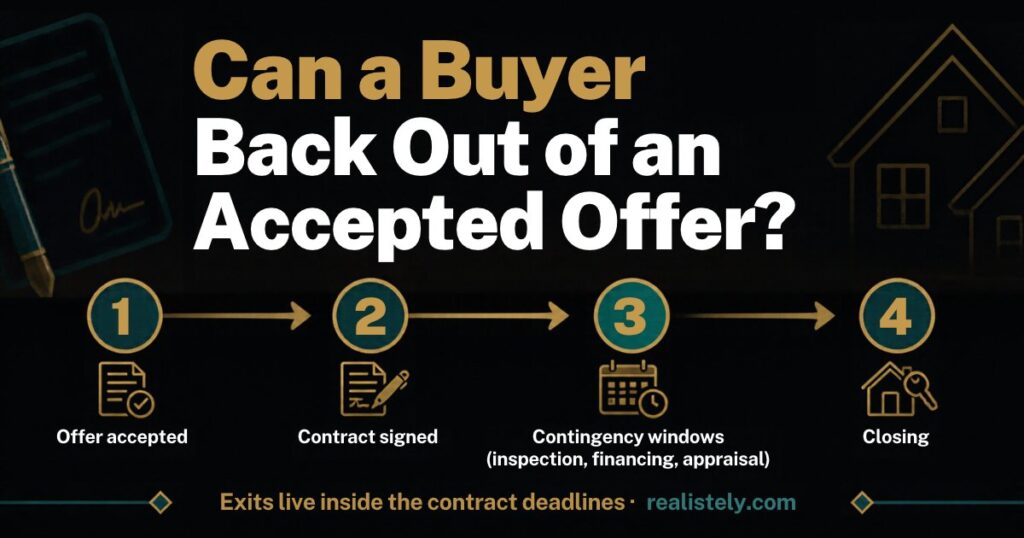
Quick answer: can a buyer back out of an accepted offer
Yes, a buyer can usually back out of an accepted offer, but whether it costs them depends on the contract. Inside a contingency window, with written notice on time, buyers often get their earnest money back. Outside those exits, the buyer may lose the deposit and, more rarely, face a claim for damages.
Key facts
- An accepted offer becomes binding once both sides sign the purchase contract.
- Contingencies (inspection, financing, appraisal and others) are the legal exits.
- Every contingency has a deadline; missing it can turn a free exit into a costly one.
- US earnest money often falls around 1–3% of the price, but it varies.
Educational only. Rules differ by state and country.
If you are asking “can a buyer back out of an accepted offer,” you are either a buyer with second thoughts or a seller worried the buyer will walk. Either way, the contract decides. This guide covers the exits, deadlines, earnest money and how to step away properly, for US readers with notes for Canada and the UK.
Key takeaways
- The signed purchase agreement sets your exits.
- Cancel under a contingency, on time and in writing.
- Missed deadlines are a common way to lose earnest money.
- Canada and the UK work differently.
Accepted offer vs signed contract: what actually binds you
In most US deals, an “accepted offer” means the seller signed your written offer, turning it into a contract with rules, dates and money attached. A verbal “yes” or an email saying “paperwork to follow” is different: real estate contracts generally must be in writing, so until both sides sign, either can usually walk away without penalty. Our guide to the real estate purchase agreement explained in plain language shows which sections create obligations.
Tip
Find the “acceptance date” in your contract. Most deadlines count from it, not from the day you made the offer.
Educational only. Answers stay in your browser.
Can a buyer back out of an accepted offer with a contingency?
Yes. Contingencies are conditions that let the buyer cancel if something specific goes wrong, each with its own deadline.
Inspection contingency
A set number of days to inspect. Depending on the wording, you may cancel for any reason in that window, or only for defects found.
Financing contingency
If the lender does not approve the loan on the stated terms, you can exit. You usually must apply promptly and act in good faith.
Appraisal contingency
If the home appraises below the price, you can renegotiate, cover the gap, or cancel.
Home-sale, title, attorney review and HOA documents
- Home-sale contingency: lets you cancel if your current home does not sell by a set date.
- Title contingency: lets you exit if title problems, such as liens, cannot be cleared.
- Attorney review: in some states, New Jersey being a well-known example, attorneys get a short window after signing to approve or cancel the contract.
- HOA or document review: time to read association rules and seller disclosures and cancel if they are not acceptable. Our guide on how to read property disclosure statements shows what to look for.
Mutual release
Both sides can agree in writing to cancel. The release should say who receives the earnest money.
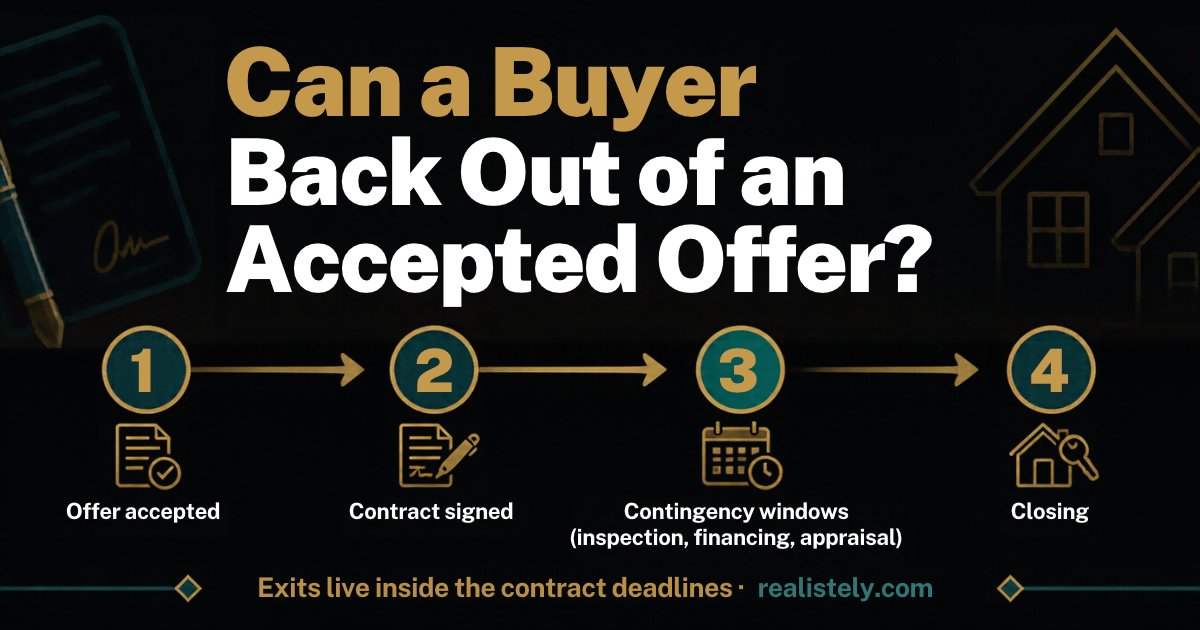
Exits compared: when each one works
| Exit | When it works | Deadline risk | Earnest money |
|---|---|---|---|
| Inspection | Within the inspection period, per contract wording | High: windows are often short | Usually returned if notice is on time |
| Financing | Loan denied despite good-faith effort | Medium: needs lender proof | Usually returned if on time |
| Appraisal | Value comes in below the price | Medium | Usually returned if on time |
| Home sale | Your current home does not sell by the date | Medium: watch kick-out clauses | Usually returned if on time |
| Title | Title defects the seller cannot clear | Low to medium | Usually returned |
| Attorney / document review | Within the review window | High: often only days | Usually returned if on time |
| Mutual release | Seller agrees in writing | None, but needs agreement | As negotiated in the release |
| No exit | Cold feet after deadlines pass | Already missed | Often kept by the seller |
Deadlines: why the calendar decides everything
A contingency only protects you while it is alive. Some contracts treat silence as approval, so saying nothing by the deadline removes it. Others need a signed removal, and the seller can send a notice demanding action. Many also say “time is of the essence,” so one day late can matter. Our timeline of what happens after your offer is accepted lays out the usual sequence so you can mark every date.
Important
Check whether deadlines count calendar or business days, and what time of day they end.
Earnest money: who keeps it if the buyer walks
Earnest money is the deposit you pay after acceptance. In the US it often falls around 1–3% of the price, though it varies. A neutral party such as a title company or attorney usually holds it. Cancel under a valid contingency on time and it usually comes back to you. Walk away without one and many contracts let the seller keep it as “liquidated damages.” The holder normally needs a signed release from both sides, or a court order, before paying anyone. The Consumer Financial Protection Bureau’s home-buying guides are a good neutral reference for the overall process.
1–3%
Common US earnest money range (varies)
In writing
How a cancellation must usually be delivered
Both signatures
What the escrow holder often needs to release funds
Realistely product
The Home Buyer Bundle
Buyer kits, checklists and spreadsheets for the steps from offer to keys, including trackers so contingency dates do not slip past you.
See what’s inside →Example: a $400,000 home, day 9 vs day 12
Example (hypothetical numbers): A buyer’s offer of $400,000 is accepted. They deposit $8,000 in earnest money, which is 2% of the price. The contract gives a 10-day inspection period starting from the acceptance date, and it treats silence after day 10 as removal of the contingency. The inspection finds foundation cracks and the buyer decides to walk.
- Day 9: The buyer’s agent delivers the contract’s cancellation form, citing the inspection contingency. The deal ends, and the $8,000 is returned once the release is signed. The buyer is out only the inspection fee.
- Day 12: The window closed two days ago, so the contingency is treated as removed. If the buyer still walks, the seller may claim the $8,000 under the contract.
Same house, same cracks, same buyer. Three days on the calendar changed an $8,000 outcome.
“A contingency is a door with a timer on it. Walk through before it closes, and in writing.”
The Realistely Team
Can a buyer back out of an accepted offer without a contingency?
Physically, yes, but it can be costly. The usual result is that the seller keeps the earnest money. Some contracts limit the seller to that deposit; others allow a claim for actual losses, such as a lower price from the next buyer. Courts can order “specific performance,” forcing a sale, but buyers use it against sellers far more often; sellers rarely force an unwilling buyer to purchase. Our guide to specific performance in real estate explains when it comes up. If you are the seller wondering about the reverse, read whether a seller can back out of an accepted offer.
Warning
Going silent does not cancel a contract, and it can weaken your position if a dispute follows.
Cash buyers: fewer exits, same rules
Cash buyers usually have no financing or appraisal contingency, so they have fewer exits. Inspection, title and document review may remain, but once those pass, backing out generally puts the earnest money at risk. Paying cash? Keep at least the inspection and title protections.
Canada and the UK: how it works there
Canada: Offers are often “conditional” on financing or inspection. Once conditions are met or waived, the deal is usually “firm,” and walking away risks the deposit and possibly a claim for the seller’s losses. Some provinces, such as British Columbia, have short rescission periods on certain purchases. Rules vary by province. The Financial Consumer Agency of Canada’s mortgage pages cover the financing side.
UK: In England and Wales, an accepted offer is generally not legally binding until contracts are exchanged. Until then, either side can usually withdraw, though survey and legal costs are lost. After exchange, backing out typically costs the deposit and possibly more. In Scotland, the deal generally binds when missives are concluded. See GOV.UK’s guide to buying and selling a home for the official overview.
How to back out of an accepted offer the right way
Read the contract. Find the contingency that applies to your reason and the exact wording of what it allows.
Check the deadline. Confirm the date, the time of day, and whether days are calendar or business days.
Send written notice on the right form. Use the cancellation or termination form your contract names, delivered through your agent or attorney the way the contract requires.
Request release of earnest money. Ask for the release form to be signed by both parties and sent to the escrow holder.
Keep copies of every report, letter and notice.
Before you send a cancellation, check
- ☐ I know which contingency I am using
- ☐ The deadline has not passed
- ☐ I am using the form the contract requires
- ☐ My agent or attorney has reviewed the notice
- ☐ I have asked for the earnest money release
- ☐ I have copies of everything

Common mistakes buyers make when backing out
- Telling the agent by phone and assuming it counts. Most contracts require written notice. A call is not a cancellation.
- Counting days from the wrong date. Deadlines usually run from the acceptance date, not the offer date.
- Waiving contingencies to win the house, then changing their mind. Once a contingency is gone, so is that exit.
- Making big credit moves before closing. A loan denial caused by your own choices may not count as a valid financing exit.
- Using a contingency for the wrong reason. Citing the inspection clause when the real issue is cold feet can lead to a dispute if the wording does not support it.
If your doubts are about cost rather than the house itself, check the numbers before you cancel. Our free Can I Afford This House calculator shows the arithmetic, and our breakdown of who pays closing costs, buyer or seller may change the picture.
For sellers: what to do if your buyer walks
First ask your agent whether the buyer cancelled under a valid contingency on time. If so, the earnest money usually goes back and you relist. If not, the contract may let you keep it, though the escrow holder may need a signed release or court decision. When new offers arrive, our free compare offers calculator lines up price, deposit and terms.
For buyers who want to stay organised
The Home Buyer Bundle
Buyer kits, checklists and spreadsheets for the steps from offer to keys: deadlines, inspection notes, costs and a review in the spirit of our final walkthrough before closing checklist.
See what’s inside →FAQ: can a buyer back out of an accepted offer
Can a buyer back out of an accepted offer before signing anything?
Usually yes. In the US, a real estate purchase generally needs a signed written contract to be enforceable. If the seller only said yes verbally, or the paperwork has not been signed by both sides, either party can typically walk away without penalty. Once both have signed and acceptance has been delivered, the contract terms control what happens next.
Do you lose earnest money if you back out?
It depends on why and when. If you cancel under a valid contingency before its deadline, with proper written notice, most contracts return your earnest money. If you back out without a valid exit, the seller may be entitled to keep it. The escrow holder usually needs both parties to sign a release, or a court order, before paying out.
Can a buyer back out after the home inspection?
Often yes, if the inspection contingency is still active. Many contracts let buyers cancel during the inspection period, sometimes for any reason and sometimes only for defects found. Once that window closes or the buyer removes the contingency, that exit is gone. Check the exact wording and deadline in your contract, and send written notice through your agent or attorney.
Can a buyer back out because of cold feet?
A buyer can always refuse to close, but cold feet alone is not a contingency. If a contingency is still open and its wording allows cancellation for any reason, the buyer may exit cleanly. Otherwise, the buyer risks losing the earnest money and possibly facing a claim for the seller’s losses. Talking with a local attorney first is wise.
Can a seller sue a buyer for backing out?
Sometimes, depending on the contract. Many contracts make the earnest money the seller’s main remedy, often called liquidated damages. Others let the seller choose between keeping the deposit or suing for actual losses. Forcing an unwilling buyer to complete the purchase through specific performance is rare. Laws and contract forms differ by state, so local advice matters.
Can a buyer back out the day before closing?
Only cleanly if a valid contingency is still open, such as a financing approval that fell through within the contract’s terms, or if the seller fails to deliver what was promised, like clear title. Otherwise, backing out at the last minute usually puts the earnest money at risk. The final walkthrough can also reveal problems that the contract may address.
Bottom line
Can a buyer back out of an accepted offer? Usually yes, and the cost depends on the contract, the contingency you use and whether you act before the deadline in writing. Read your agreement now, mark every date, and talk to a local agent or attorney before you send anything. For more guides, browse our buying a home articles.
Educational only, not legal advice. Contract terms and laws differ by state, province and country; ask a local real estate attorney or agent about your contract.
Sources: Consumer Financial Protection Bureau (consumerfinance.gov), GOV.UK buying and selling a home guidance, Financial Consumer Agency of Canada. Written by The Realistely Team.