
A seller net sheet is a line-by-line estimate of the cash you’ll actually walk away with after you sell your home, once the mortgage, commissions, taxes, fees and credits come out of the sale price. The contract price is never the money that lands in your account, and sellers who build one before listing price smarter, negotiate calmer and rarely get surprised at the closing table.
This guide covers US home sales, with short notes for Canada and the UK. Costs, transfer taxes and who pays what differ by state, county and contract, so treat every figure below as an example, not a quote. It’s education only, not legal, tax or financial advice. Your title company, attorney or tax pro has the final word on your numbers.
Reviewed by The Realistely Team · Sources cited below
Quick answer
A seller net sheet estimates your cash at closing: sale price plus any credits owed to you, minus your mortgage payoff, commissions, transfer tax, title and escrow fees, prorated property taxes, HOA charges and any credits you give the buyer. Build one before listing and again for every offer, then check it against your final settlement statement.
Key facts
- It’s an estimate made before closing, not the official closing document.
- Your mortgage payoff is usually the biggest deduction, and it grows by a daily interest amount.
- Commissions are negotiable and vary; there’s no standard rate.
- Transfer tax rates and who pays them depend on your state and county.
- Concessions and repair credits come straight out of your net, dollar for dollar.
- Capital gains tax isn’t on the net sheet; the IRS home sale exclusion is a separate question.
Free tool
Net Proceeds Estimator
Type in your price, payoff and costs and see your estimated net in a minute. It does the arithmetic only and shows every line, so you can check it against the example in this guide.
Open the free estimatorThe one formula to remember
Net = Sale price + credits to you − everything you owe
Every line is a credit (money to you) or a debit (money leaving). Take each from a real document.
Educational only. Answers stay in your browser.
What is a seller net sheet?
A seller net sheet is a worksheet that turns a sale price into an estimated cash-to-seller figure. Your agent or title company usually prepares it, or you can build one yourself with the right paperwork.
Think of it as a rehearsal for closing. A net sheet built on “about 8% for costs” is a guess. One built on a payoff letter, a tax bill and the HOA’s fee schedule is a plan.
You’ll want one at three moments: before you set a price, when each offer arrives, and after inspection negotiations, when repair credits change the math. If you’re still working out a list price, pair it with a comparative market analysis so the top line is grounded too.
Watch: How to sell a house step by step (8-minute master class)
Seller net sheet vs settlement statement vs Closing Disclosure: what’s the difference?
The net sheet is your estimate before closing, the settlement statement is the final itemized record at closing, and the Closing Disclosure is the buyer’s lender form for the loan. They overlap, but they come from different people at different times and answer different questions.
The settlement statement is the one that actually moves your money. Many title and settlement companies use standard ALTA settlement statement forms, which come in seller, buyer, cash and combined versions. We walk through every section in our seller settlement statement guide. The Closing Disclosure belongs to the buyer’s mortgage: the CFPB describes it as a five-page form with the final loan details, which the lender must give the borrower at least three business days before closing. If you want the buyer-side view, read our Closing Disclosure explainer.
| Document | Who makes it | When | What it’s for | Binding? |
|---|---|---|---|---|
| Seller net sheet | You, your agent or a title company | Before listing and for each offer | Estimate your cash at closing and compare offers | No, estimate only |
| Settlement statement (ALTA or similar) | Title, escrow or closing attorney | A few days before closing, finalized at closing | Itemize every credit and debit for the seller and buyer | Yes, it’s the final accounting |
| Closing Disclosure | Buyer’s lender | At least three business days before closing | Show the buyer’s final loan terms and costs | Yes, for the loan |
US documents. Forms and names vary by state and by closing company.
Important
Your net sheet and your settlement statement should tell the same story. If a line on the final statement is unfamiliar or much bigger than your estimate, ask about it before you sign, not after.
What goes on a seller net sheet?
Every net sheet has two columns: credits to you and debits from you. These lines show up on most US sales:
- Sale price (credit): the contract price, not the list price.
- Prepaid items (credit): HOA dues you’ve already paid past closing.
- Mortgage payoff (debit): principal, interest to the payoff date and lender fees, plus any second loan or HELOC.
- Commissions (debit): your listing agreement terms plus any buyer-agent pay you agree to. Both are negotiable.
- Transfer or excise tax (debit): set by state, sometimes county or city. Some states have none.
- Title and escrow (debit): owner’s policy if sellers pay it locally, your settlement fee share, recording.
- Property tax proration (debit or credit): depends on whether taxes are paid ahead or behind in your area.
- HOA charges (debit): transfer fee, resale certificate, any unpaid dues or special assessments.
- Buyer concessions and repair credits (debit): every dollar you agree to give.
- Other (debit): attorney fees, liens, final utility bills, a small cushion.
Who pays which of these is partly local custom and partly negotiation. Our guide to who pays closing costs breaks down the usual split, and it’s the page to read if you’re not sure whether the title policy is yours.

How do you calculate a seller net sheet? A worked $425,000 example
Start with the sale price, add credits, subtract every debit, and the result is your estimated net. Here’s a full example on a US $425,000 sale. Every rate and fee below is an assumption chosen for the example, so swap in your own numbers from your own documents.
1
Get the payoff letter
Ask your lender for a payoff statement good through your expected closing date. Note the daily interest figure.
2
Write down the deal terms
Price, concessions, repair credits and closing date come from the purchase contract and any amendments.
3
Collect local costs
Ask the title or escrow company for a fee quote, the transfer tax rate and how taxes are prorated in your county.
4
Do the math and add a cushion
Credits minus debits. Keep a small cushion for final utility bills and rounding.
Example assumptions (US, illustration only): mortgage balance of $238,400 at 4.5%, total commission of 5.5% (commissions are negotiable and vary by market and agreement; this isn’t a standard rate), a transfer tax of $4 per $1,000 of price (an example rate only; real rates vary by state and county and some states charge none), annual property taxes of $5,100 paid in arrears, HOA dues of $300 a month paid in advance, a $6,000 concession toward the buyer’s closing costs and a $3,500 repair credit after inspection.
Property tax proration arithmetic: $5,100 ÷ 365 = about $13.97 a day. If you’ve owned the home for 166 days of the current tax year at closing and the bill hasn’t been paid yet, you owe the buyer $5,100 ÷ 365 × 166 = $2,319.45 (rounding the daily rate first would give $2,319.02). In areas where taxes are paid ahead, this flips into a credit to you.
Payoff per-diem arithmetic: $238,400 × 4.5% ÷ 365 = $29.39 a day. Twenty days of interest since your last payment adds $587.80, and the lender’s payoff and release fees add $75, so the payoff is $238,400 + $587.80 + $75 = $239,062.80.
HOA credit: dues of $300 a month work out to $10 a day. You’ve paid through the end of the period and 14 days fall after closing, so the buyer reimburses you 14 × $10 = $140.
| Line | Credit to you | Debit from you | Where the number comes from |
|---|---|---|---|
| Sale price | $425,000.00 | Purchase contract | |
| HOA dues prepaid past closing (14 days × $10) | $140.00 | HOA statement | |
| Mortgage payoff incl. 20 days per-diem and fees | $239,062.80 | Lender payoff letter | |
| Commission, 5.5% total (example, negotiable) | $23,375.00 | Listing agreement and offer terms | |
| Transfer tax, $4 per $1,000 (example rate) | $1,700.00 | State and county rate | |
| Title and escrow (owner’s policy, settlement share, recording) | $2,750.00 | Title company fee quote | |
| Property tax proration (166 days of a $5,100 bill) | $2,319.45 | County tax bill | |
| HOA transfer and resale certificate fees | $400.00 | HOA fee schedule | |
| Seller concession to buyer’s closing costs | $6,000.00 | Purchase contract | |
| Repair credit after inspection | $3,500.00 | Inspection amendment | |
| Totals | $425,140.00 | $279,107.25 | |
| Estimated net to seller | $146,032.75 | Credits minus debits |
US example with assumed figures. Your rates, fees and customs will differ by state, county and contract.
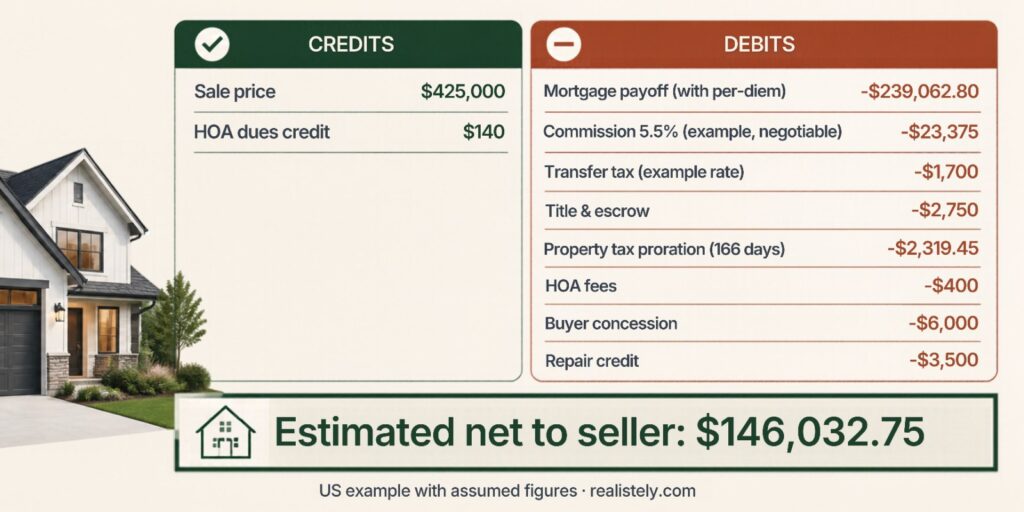
A $425,000 sale nets about $146,000 here. The mortgage takes the most, but the $9,500 in concessions and credits beats the transfer tax, title and HOA fees combined, and it’s the part you control at the negotiating table.
Free tool
Run your own numbers
Put your payoff, price and local costs into the Net Proceeds Estimator. Every line is shown with its formula, so you can match it to the table above.
Try the Net Proceeds EstimatorTip
Ask for the payoff letter early and again a few days before closing. Late fees or a missed autopay can change it.
“The price is what the buyer pays. The net is what you get. Negotiate on the second number.”
The Realistely Team
What changes your net the most?
Commission rate, credits to the buyer and the price itself move your net far more than the closing date or small fees. Here’s how the example above shifts when you change one thing at a time.
| Change (one at a time) | Effect on net | Estimated net |
|---|---|---|
| Starting example | — | $146,032.75 |
| Commission 1 point lower (4.5%) | +$4,250.00 | $150,282.75 |
| Commission 1 point higher (6.5%) | −$4,250.00 | $141,782.75 |
| Closing a week later (7 more days of payoff interest and tax proration, 7 fewer days of HOA credit) | −$373.54 | $145,659.21 |
| An extra $5,000 credit to the buyer | −$5,000.00 | $141,032.75 |
| Price $10,000 lower (commission and transfer tax shrink too) | −$9,410.00 | $136,622.75 |
Same US example assumptions as above. Arithmetic only; check your own contract and costs.
A credit costs exactly what it says, while a price cut is softened slightly because commission and transfer tax shrink with it. A one-week delay costs a few hundred dollars, rarely worth losing a strong buyer over. If you’re racing a deadline, our guide to selling a house fast covers the trade-offs.
From the Realistely library
Plan the whole sale, not only the numbers
The Home Seller Bundle gives you the spreadsheets, checklists and step-by-step guides to price, prepare, negotiate and close, including a ready net sheet you can fill in for every offer.
See The Home Seller BundleDigital download · All sales final
How do you compare two offers with a net sheet?
Run a separate net sheet for each offer and compare the bottom lines, not the prices. A higher offer loaded with concessions and credits can easily net less than a lower, clean one.
Here’s a quick example using the same home. Offer A is $435,000 with $10,000 toward the buyer’s closing costs, a $4,000 repair credit and a closing two weeks later. Offer B is $425,000, no concessions, sold as-is, closing on schedule. Only the lines that differ are shown; the payoff, title, HOA fees and the rest stay about the same in both.
| Line that differs | Offer A: $435,000 with credits | Offer B: $425,000 clean |
|---|---|---|
| Price | $435,000.00 | $425,000.00 |
| Commission, 5.5% (example) | −$23,925.00 | −$23,375.00 |
| Transfer tax, $4 per $1,000 (example) | −$1,740.00 | −$1,700.00 |
| Concession to buyer | −$10,000.00 | $0.00 |
| Repair credit | −$4,000.00 | $0.00 |
| 14 extra days: payoff interest, tax proration, HOA credit | −$747.08 | $0.00 |
| Subtotal of the lines that differ | $394,587.92 | $399,925.00 |
US example with assumed figures. Offer B nets about $5,337 more in this illustration.
The $10,000 higher price loses by about $5,300, before counting risk: a buyer who needs big concessions may be stretched on financing, and a later closing leaves more room for trouble. The Compare Offers Calculator lines up two to four offers this way in seconds. If you’ve got several on the table at once, read our multiple-offer tips before you counter.
Warning
Don’t accept a higher price that only appraises at a lower one. If the appraisal comes in short, a financed buyer may ask you to cut the price or walk, and your net sheet for that offer goes out the window.
What should you gather before you build a seller net sheet?
Gather the documents that hold your real numbers: the payoff letter, your tax bill, the HOA statement and the contract terms. The checklist below covers every line in the example.
Net sheet document checklist
- Mortgage payoff statement for each loan (first mortgage, second, HELOC) with the per-diem interest figure
- Latest property tax bill and whether your county collects taxes ahead or behind
- HOA statement: dues paid-through date, transfer fee, resale certificate fee, special assessments
- Listing agreement showing your commission terms
- Purchase contract and any amendments: price, concessions, repair credits, closing date
- Title or escrow fee quote, including the owner’s title policy if the seller pays it locally
- Transfer tax rate for your state, county and city
- Any liens, judgments or unpaid contractor bills tied to the property
- Final utility bills you’ll settle (water, sewer, trash) if your area adds them to closing
- Attorney fee quote if your state uses closing attorneys
Selling a place with known issues? Repair credits can be the biggest swing line, so read our guide on selling a house that needs repairs before you decide between fixing and crediting.
What are the most common seller net sheet mistakes?
Most bad estimates come from five habits, and each one is easy to fix.
1. Using the balance on your statement instead of a payoff letter
Your statement shows principal only. The payoff adds interest since your last payment plus fees, several hundred dollars on the example loan.
2. Forgetting that the payoff grows every day
Interest runs until the lender receives the money, so every day a closing or wire slips adds the per-diem amount.
3. Leaving concessions and credits off the sheet
Sellers watch the price and forget the concession or the later repair credit. Update the sheet every time the contract changes.
4. Borrowing a transfer tax rate from another state
Transfer taxes range from none to significant, and some cities add their own on top. Ask your title company for the exact rate and who customarily pays it where you live.
5. Treating the net sheet as the final number
It’s an estimate. Compare it line by line with the settlement statement before closing. For more traps that cost sellers money, see our top home-selling mistakes.
What should you ask your agent or title company for?
Ask for a written net sheet for each offer, built from a current payoff and a real fee quote. Here’s a short script you can send as an email or use on a call.
Copy-ready script
“Hi, before I accept an offer I’d like a written seller net sheet for each one we’re considering. Could you please:
- Use my current payoff with interest to the expected closing date?
- List the transfer tax rate you’re using and who pays it by custom here?
- Include the title company’s fee quote, the owner’s policy if I pay it, and recording?
- Show the property tax proration and how our county collects taxes?
- Add HOA fees, concessions and any repair credits as separate lines?
And when the settlement statement is ready, please send it a few days before closing so I can check it against this estimate. Thanks.”
Selling without an agent? The title or escrow company will usually prepare a seller estimate if you ask, and our FSBO guide covers what else falls on your plate.
Is a seller net sheet different in Canada or the UK?
The idea is the same everywhere, but the big lines change. In Canada, land transfer tax is generally a buyer cost, while sellers typically pay the agent commission plus sales tax on that commission, legal fees, and a mortgage discharge fee or prepayment penalty that can be large if you break a fixed-rate term early. In the UK, Stamp Duty Land Tax falls on the buyer; sellers usually pay the estate agent’s fee plus VAT, the conveyancing solicitor and any early repayment charge on the mortgage. Ask your local lawyer or conveyancer for exact figures.
Do you pay tax on the money you walk away with?
Not always, and it isn’t on the net sheet either way. Your net is cash, while capital gains tax is calculated on your gain: the amount realized minus your adjusted basis. Under IRS Publication 523, you may be able to exclude up to $250,000 of gain, or $500,000 for a married couple filing jointly, if you meet the ownership and residence tests, generally at least two years each out of the five years before the sale. Selling costs like commissions reduce the amount realized. Talk to a tax pro if your gain could be near those limits.
From the Realistely library
Walk into closing knowing your number
The Home Seller Bundle includes a fill-in seller net sheet, an offer comparison sheet, a prep checklist and plain-language guides for every step from pricing to keys. Educational tools, built for US sellers.
Get The Home Seller BundleDigital download · All sales final
Seller net sheet FAQ
Who prepares a seller net sheet?
Usually your listing agent prepares the seller net sheet, often using a template from the title or escrow company. Title companies will also run one on request, and you can build your own from your payoff letter, tax bill, HOA statement and contract. Whoever makes it, ask what assumptions they used for commission, transfer tax and proration so you can check each line yourself.
How accurate is a seller net sheet?
A good one lands within a small margin of the final settlement statement, as long as it uses a current payoff letter, a real title fee quote and the actual contract terms. Accuracy drops when it relies on percentages or old numbers. Expect small differences from per-diem interest, final utility bills and rounding, and keep a modest cushion for them.
Is a seller net sheet the same as a closing statement?
No. A net sheet is an estimate you make before closing to plan and compare offers. The closing or settlement statement is the final itemized accounting prepared by the title company, escrow officer or closing attorney, and it controls the money that’s actually paid out. Compare the two line by line a few days before closing and ask about any differences.
Does a seller net sheet include capital gains tax?
Normally it doesn’t. The net sheet shows cash at closing, while capital gains tax depends on your gain and is handled on your tax return. In the US, many homeowners can exclude up to $250,000 of gain, or $500,000 for married couples filing jointly, if they meet the IRS ownership and use tests. Ask a tax professional about your situation.
When should I ask for a seller net sheet?
Ask before you set a list price, again when each offer comes in, and once more after inspection negotiations. Each stage can change the bottom line. Building one before listing helps you choose a price that covers your payoff and moving plans, and running one per offer stops a higher headline price from hiding bigger credits or slower closing costs.
Can I make my own seller net sheet?
Yes. Start with the sale price and any credits owed to you, then subtract your mortgage payoff, commissions, transfer tax, title and escrow fees, prorated property taxes, HOA charges, concessions and repair credits. Use real documents for each figure and a free net proceeds calculator to check your arithmetic. Then ask your title company to confirm local costs and customs.
Bottom line
A seller net sheet turns a price into a plan. Build it from real documents, update it with every offer and every amendment, and check it against your settlement statement before you sign. The mortgage payoff is fixed by your loan, but commissions, concessions and credits are where your choices show up in the final number. Start with our cornerstone guide to who pays closing costs, and browse more seller guides in our selling a home section.
Disclaimer
This article is for general education about US home sales, with brief notes on Canada and the UK. It isn’t legal, tax, financial or real estate advice. Every figure in the examples is an assumption for illustration. Commissions are negotiable, and costs, transfer taxes, proration methods and customs vary by state, county, city and contract. Confirm your numbers with your title company, closing attorney, lender or tax professional.
Sources