
A seller settlement statement is the itemised list of every dollar in your home sale: what the buyer pays you, what comes out for your mortgage, commissions, taxes and fees, and the net amount that lands in your bank account. Read it before closing day, line by line, because a wrong payoff figure or a missed credit comes straight out of your pocket.
This guide shows what the statement looks like, how credits and debits work, how property tax prorations are worked out, and walks through a full example from a $400,000 sale to the final net figure. It covers US home sales; the form names and who pays which fee differ by state, so use it to ask better questions, not as legal or tax advice.
Reviewed by The Realistely Team · Sources cited below
Quick answer
A seller settlement statement (often an ALTA seller statement or the seller’s Closing Disclosure) lists your credits and debits at closing. Credits are money owed to you, mainly the sale price. Debits are money taken out: mortgage payoff, commissions, transfer tax, title and escrow fees, credits to the buyer and prorated bills. Net proceeds = total credits minus total debits.
Key facts
- The title company, escrow agent or closing attorney prepares it, not your agent.
- Under the federal TRID rule the settlement agent must give the seller a Closing Disclosure no later than the day of closing; many also add an ALTA or state statement.
- Your mortgage payoff is usually the biggest debit: check it against a payoff letter from your lender.
- Property tax, HOA dues and similar bills are split by date (prorated), so you may get a credit or a debit.
- Ask for a draft 2 to 3 days before closing and compare it with your net sheet.
Free tool: Home Sale Net Proceeds Estimator
Put in your price, payoff, commission and costs to see the number you should expect at the bottom of your statement, with the formula shown.
Estimate my net proceeds →
Educational only. Answers stay in your browser.
What is a seller settlement statement?
A seller settlement statement is the closing document that shows every charge and credit on your side of the sale and the cash you receive at the end. Think of it as the receipt for your home sale. It is prepared by whoever runs the closing: a title company, an escrow company or, in some states, a closing attorney.
You may see it under several names. The ALTA Settlement Statement comes in seller, buyer, combined and cash versions. The seller’s Closing Disclosure is the federal form the settlement agent must give a seller when the buyer uses a mortgage. Older or some cash deals may still use a HUD-1. Some states have their own form. The layout differs; the logic is the same.
| Document | Who prepares it | What it shows the seller |
|---|---|---|
| Seller’s Closing Disclosure | Settlement agent (title, escrow or attorney) | Your side of the sale on the federal form, by the day of closing |
| ALTA seller settlement statement | Title or escrow company | Your debits and credits in detail, often with more line items |
| Combined ALTA statement | Title or escrow company | Buyer and seller columns side by side |
| Seller’s net sheet | Your listing agent, early in the sale | An estimate only, not a closing document |
How do credits and debits work on the statement?
A credit is money owed to you. A debit is money taken from you. Your net proceeds are your total credits minus your total debits. That one rule explains the whole page.
- Credits to the seller: the sale price, plus any bills you paid in advance for days after closing (for example HOA dues or property tax paid ahead).
- Debits to the seller: your mortgage payoff and any other liens, agent commissions you agreed to, transfer tax where the seller pays it, title and escrow fees on your side, any credit you agreed to give the buyer, and your share of bills not yet paid (often property tax paid in arrears).
The buyer’s earnest money deposit sits on the buyer’s side as a credit to them. It is part of how the price gets paid, so it does not add to your net; you receive the full price through the closing.
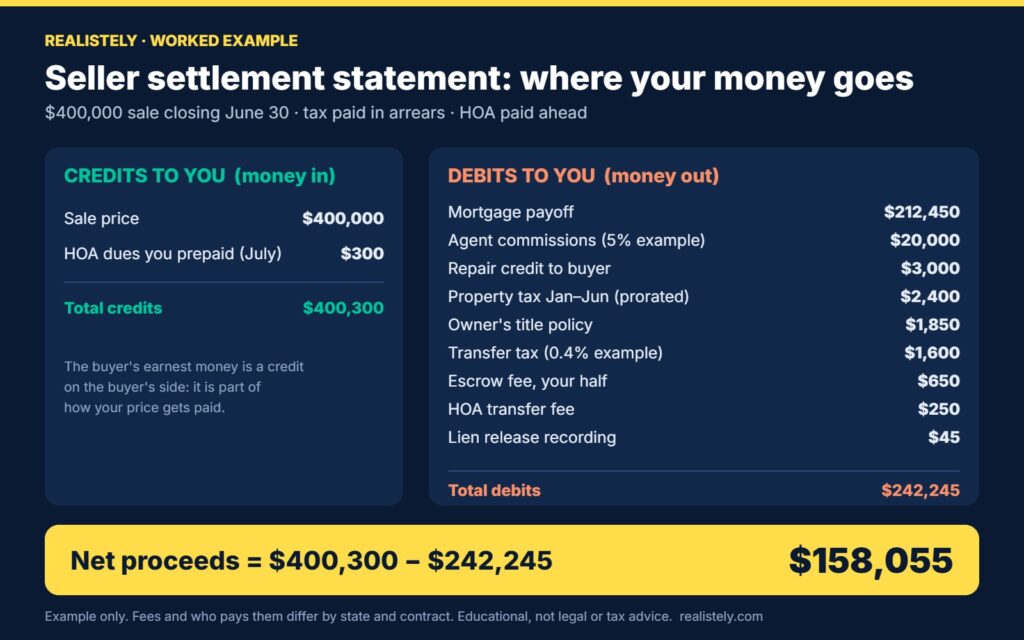
What does a seller settlement statement look like? A worked example
Here is a simple example of a $400,000 sale closing on June 30, with property tax paid in arrears and HOA dues paid one month ahead. The numbers are made up to show the arithmetic; your fees and who pays them depend on your state, your contract and your listing agreement.
| Line item | Credit to seller | Debit to seller |
|---|---|---|
| Sale price | $400,000 | |
| HOA dues for July, already paid by the seller | $300 | |
| Mortgage payoff (principal plus interest to the payoff date) | $212,450 | |
| Agent commissions agreed in the listing agreement (5% in this example) | $20,000 | |
| Repair credit to the buyer after inspection | $3,000 | |
| Property tax for January to June, not yet paid (prorated) | $2,400 | |
| Owner’s title insurance policy (seller-paid in many areas) | $1,850 | |
| Transfer tax (0.4% in this example) | $1,600 | |
| Escrow or settlement fee, seller’s half | $650 | |
| HOA transfer and document fee | $250 | |
| Recording fee for the mortgage release | $45 | |
| Totals | $400,300 | $242,245 |
| Net proceeds to seller | $400,300 − $242,245 = $158,055 | |
Commissions are negotiable and are set in your listing agreement and the purchase contract; how the buyer’s agent is paid also varies. Treat the 5% above as an example, not a norm.
How are property tax prorations worked out?
A proration splits a bill by the days each owner held the home. You pay for the days you owned it; the buyer pays from closing on. Whether it becomes a credit or a debit depends on whether the bill was already paid.
- Find the yearly bill. Example: $4,800 property tax for the year.
- Work out your share. You owned January to June, half the year: $4,800 × 6 / 12 = $2,400. Some closings use a daily rate and the exact number of days, which gives a slightly different figure.
- Decide the direction. If the tax is paid in arrears (not yet paid), your $2,400 is a debit to you and a credit to the buyer, who will pay the whole bill later. If you prepaid the year, the buyer’s share is a credit to you.
The same logic applies to HOA dues, and in some sales to water, sewer or rent from a tenant. Ask the closing agent which bills they prorated, which dates they used and whether the tax figure is this year’s bill or an estimate from last year.

How do you check a seller settlement statement before closing?
Ask the closing agent for a draft two to three days before closing and check it against your contract, your net sheet and your lender’s payoff letter. Most mistakes are small typing or date errors, and they are easy to fix before you sign and hard to fix after.
- Names, address and closing date match your contract.
- Sale price matches the final contract, including any price change after inspection.
- Mortgage payoff matches a recent payoff letter, with interest through the right date. A second mortgage or home equity line must be listed too.
- Commissions match the percentages or amounts in your listing agreement and contract.
- Seller credits to the buyer (closing costs or repairs) match what you agreed in writing, no more.
- Prorations use the right yearly amounts and the closing date.
- Fees you did not expect: ask what each one is and why it is on your side.
- Wire details for your proceeds: confirm them by phone with the closing office, using a number you already trust. Never act on emailed wiring changes.
Why is my net lower than the agent’s net sheet?
A net sheet is an early estimate; the settlement statement uses final figures. The gap usually comes from a few lines: a payoff that includes more interest than expected, a repair credit agreed after inspection, a property tax proration based on a higher bill, an HOA payoff or transfer fee nobody mentioned, or a second lien such as a home equity line. Each one should be traceable to a document. If a line is not, ask before closing.
Selling soon? Get every step on paper
The Home Seller Bundle has the pricing worksheet, the prep checklists, the offer comparison and the net proceeds spreadsheet, so the numbers on your settlement statement hold no surprises.
See the Home Seller Bundle →
Related guides
- Who pays closing costs, buyer or seller?
- Closing Disclosure explained page by page
- Home sale net proceeds estimator
- Compare two offers in net cash
Seller settlement statement: FAQ
Who prepares the seller settlement statement?
The settlement agent who runs the closing: a title company, an escrow company or a closing attorney, depending on the state. Your listing agent can check it with you but does not prepare it.
Is the seller settlement statement the same as the Closing Disclosure?
Not always. When the buyer has a mortgage, the settlement agent must give the seller a Closing Disclosure for the seller’s side by the day of closing. Many closings also give an ALTA or state settlement statement with more line detail. Both should show the same net figure.
When do sellers get the settlement statement?
The final version comes at or just before closing. Ask for a draft two to three days early so you have time to check the payoff, credits and prorations and to get errors fixed before you sign.
What is a debit to the seller?
Any amount taken out of your proceeds: mortgage payoff, commissions, transfer tax where the seller pays it, title and escrow fees on your side, credits you give the buyer and your share of unpaid bills such as property tax paid in arrears.
Why do I owe property tax at closing?
In many places property tax is paid after the period it covers. The buyer will pay the full bill later, so you give the buyer a credit for the months you owned the home. If you prepaid, the buyer credits you instead.
Should I keep my settlement statement?
Yes. Keep a copy with your sale records. It shows the sale price and selling costs, which you or your tax adviser may need when you report the sale. Tax rules differ by country and situation, so ask a tax professional.
Sources
- ALTA: Who handles preparation and delivery of the seller’s Closing Disclosure
- ALTA: Settlement statements (seller, buyer, combined and cash versions)
- eCFR: 12 CFR 1026.38, content of the Closing Disclosure
Educational only, not legal, tax or financial advice. Closing documents, fees and who pays them differ by state, contract and lender. Ask your closing agent or attorney about your own sale.